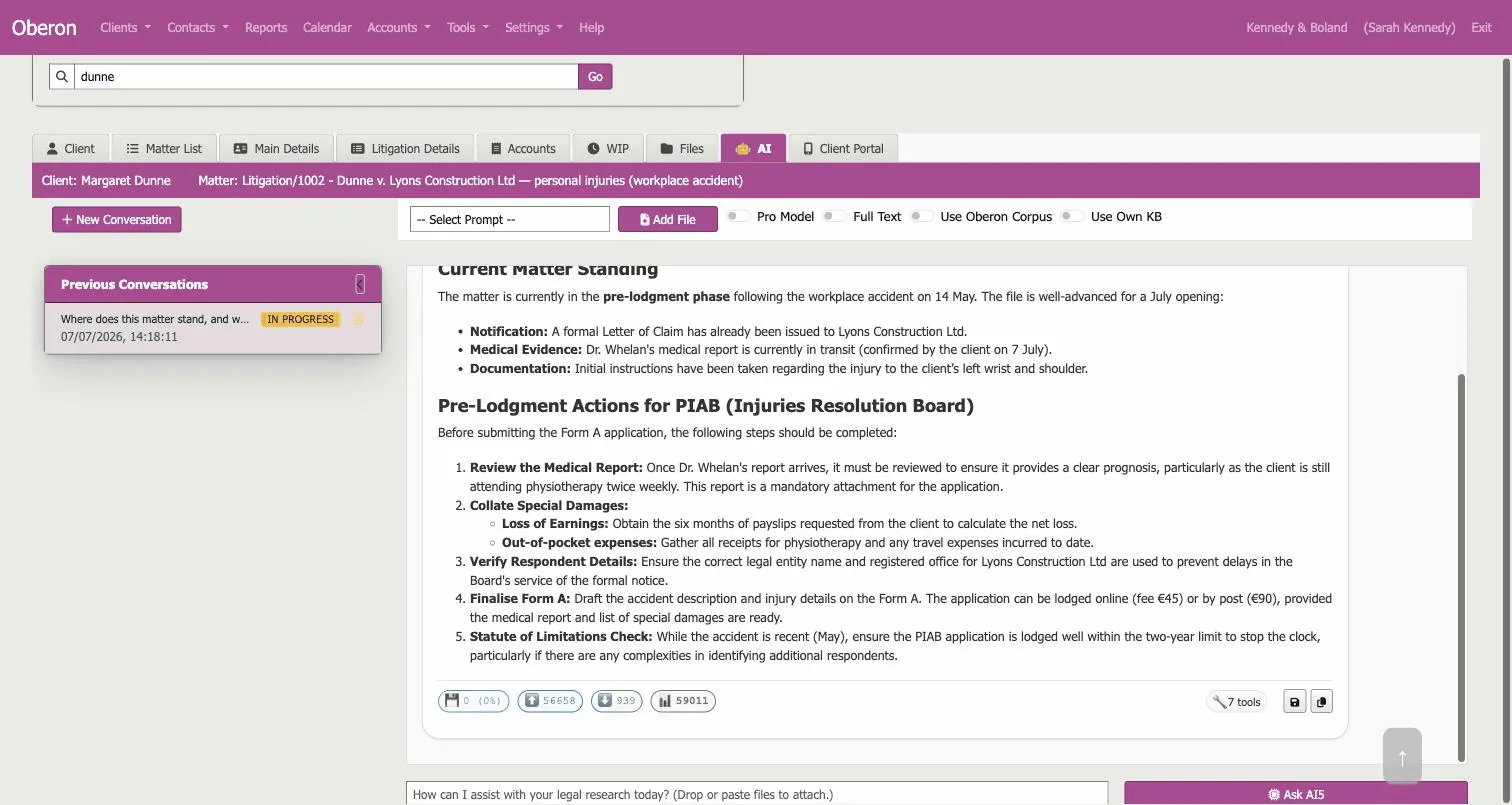
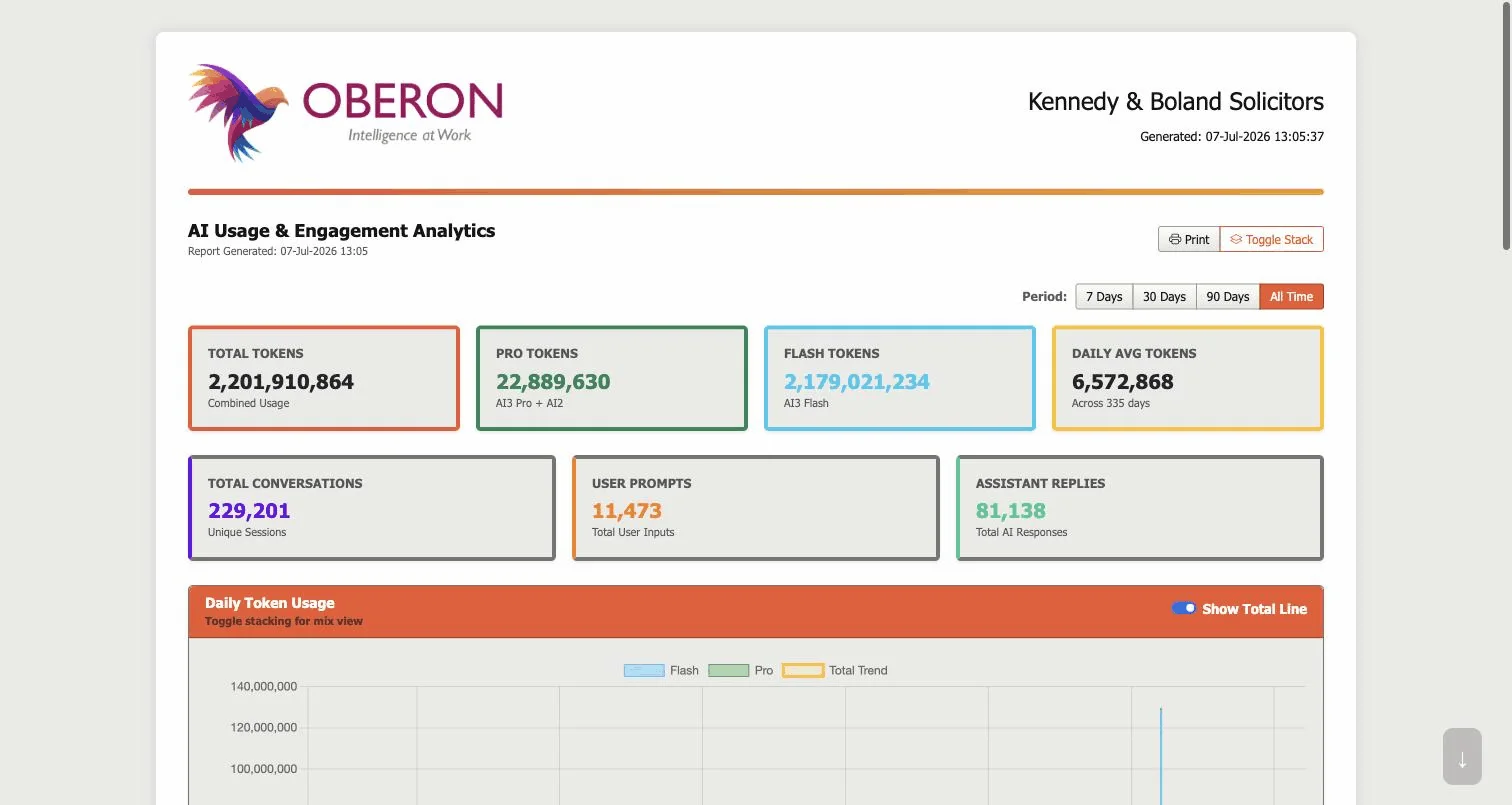
Oberon’s artificial intelligence isn’t a marketing checkbox. It’s a deeply integrated capability that transforms how your firm researches, drafts, analyses, and delivers.
A sophisticated conversational AI that can research, analyse, draft, and execute multi-step tasks using your firm’s tools and data.
Upload your firm’s documents to create a secure, searchable AI knowledge base. Get answers grounded in your own expertise and precedents.
AI capabilities woven into every workflow — from one-click document summaries to intelligent text polishing and automated note creation.
Oberon’s AI Chat is built on a tool-agnostic architecture using the Model Context Protocol (MCP). This means the AI dynamically discovers and uses any available tool — searching cases, reading documents, creating notes — without rigid pre-programming.
Retrieval-Augmented Generation (RAG) gives your AI access to your firm’s collective knowledge — securely and privately.
Add your firm’s documents, memos, precedents, and templates to the secure knowledge base.
Documents are intelligently chunked, indexed, and made searchable using semantic understanding.
Ask questions in natural language. The AI retrieves relevant context and generates grounded, accurate answers.
Attach any document to an AI prompt for instant summarisation, clause extraction, or risk analysis.
One-click AI refinement of case notes, correspondence, and memos for clarity, grammar, and professional tone.
Save and categorise frequently used prompts by department. Standardise AI usage across your firm.
Convert any AI response directly into a WIP note, memo, or document within the relevant matter.
Engage the advanced reasoning engine for complex multi-step legal analysis with transparent chain-of-thought.
Generate first drafts of letters, opinions, and memos using your firm’s style and templates.
Client confidentiality isn’t negotiable. Oberon’s AI is designed from the ground up with legal ethics and data protection at its core — not bolted on as an afterthought.
Every AI interaction operates within strict permission boundaries. Your firm’s data is processed exclusively on EU infrastructure, never used for model training, and subject to the same rigorous security standards that govern every other part of the Oberon platform.
Whether you’re a sole practitioner handling sensitive family law matters or a multi-office firm managing commercial litigation, Oberon’s AI meets the highest standards of professional responsibility and regulatory compliance.
Research precedents, analyse opposing arguments, draft submissions, and prepare for hearings with AI-assisted analysis.
Review property documents, extract key terms, generate requisitions, and manage completion checklists automatically.
Analyse contracts, summarise due diligence materials, draft board minutes, and track compliance obligations.
Assess medical reports, calculate quantum, draft instructions to counsel, and manage settlement negotiations.
Go beyond chat. Oberon’s Deep AI performs multi-iteration, branching analysis with built-in self-critique to produce formal expert opinions and assessments comparable to those of leading professionals.
Where the AI Chat answers questions conversationally, Deep AI runs a structured multi-pass reasoning pipeline in the background. It frames the problem, generates investigative branches, explores each in depth, critiques its own reasoning through a built-in Devil’s Advocate module, and synthesises everything into a formal written assessment.
The system automatically detects when its reasoning has converged — requiring at least 90% confidence across multiple iterations before producing its final output. The result is a structured expert report, not a chat response.
The Pipeline
Choose the expert perspective that fits your matter. Each persona reconfigures the entire reasoning pipeline — from how questions are framed to how the final assessment is structured.
Senior Barrister
Formal opinions, case law analysis
Medical Doctor
Clinical assessments, medical evidence
Consultant Engineer
Technical assessments, building defects
Computer Scientist
Technical analysis, system architecture
Accountant
Financial assessments, tax analysis
Forensic Accountant
Fraud analysis, asset tracing
Strategist
Power dynamics, competitive strategy
Negotiator
Deal strategy, dispute resolution
Behavioural Scientist
Persuasion, consumer behaviour
Politician
Political strategy, stakeholder mgmt
OSINT Investigator
Due diligence, intelligence gathering
Compliance Expert
Regulatory, data protection
Crisis Comms Advisor
Reputation, media strategy
Economist
Damages quantification, valuation
Digital Forensics
E-discovery, cybersecurity
Psychologist
Behavioural analysis, mental health
Criminal Analyst
Criminal schemes, modus operandi
Philosopher
Ethical analysis, argumentation
Deep AI doesn’t produce chat responses. It generates formal, structured expert reports that follow the conventions of each profession. A Senior Barrister opinion follows the structure of a real counsel’s opinion. A medical assessment follows clinical reporting standards. An engineering report follows professional engineering conventions.
RE: Murphy v. Dublin City Council — Public Liability Claim
Formal Opinion of Senior Counsel
QUESTIONS PRESENTED
Whether the Council owed a duty of care to the Plaintiff in respect of the footpath defect at Grafton Street, and whether contributory negligence may reduce any award of damages.
SHORT ANSWER
In my opinion, the Council did owe a duty of care. The defect was known and unremedied for a period exceeding six weeks. However, contributory negligence of approximately 15–20% is likely given the Plaintiff’s admitted familiarity with the route.
DETAILED LEGAL ANALYSIS
The duty of care analysis proceeds from the principles established in Glencar Exploration v. Mayo County Council [2002] 1 IR 84, as further developed in Breslin v. Corcoran [2003] 2 IR 203...
RISK PROFILE
Primary risk: the Council may argue the defect was “trivial” under the de minimis threshold. Mitigation: photographic evidence and engineer’s report establish a depth of 38mm…
3 iterations • 9 branches explored • Convergence: 94% • 47,000 tokens
Register free to experience Oberon’s AI in action with your own use cases.